
The Library is an integral part of the University. Its main function is to provide library resources to students, academic, visiting, scientific, and administrative personnel.
The library has standard spaces that provide a conducive, comfortable environment for educational and scientific activities.
The library works every day except Sunday and official holidays.The library’s working hours are:
Monday-Friday: 09:00 – 20:00
Saturday: 10:00 – 16:00
Library resources are constantly updated. The fund is registered in the electronic catalog. Digital literature provided by educational programs is uploaded to the electronic library. International scientific databases are also available. Access to electronic databases and the electronic catalog of books is possible both in the library and remotely.
More information about library goals, structure and other important issues is set out in the Library Regulation and Library Rules.
Regulation of the Library
Library Rules
Library Services
Reading Hall – The library has a well-equipped reading hall, where students and academic staff can work in a quiet and comfortable environment.

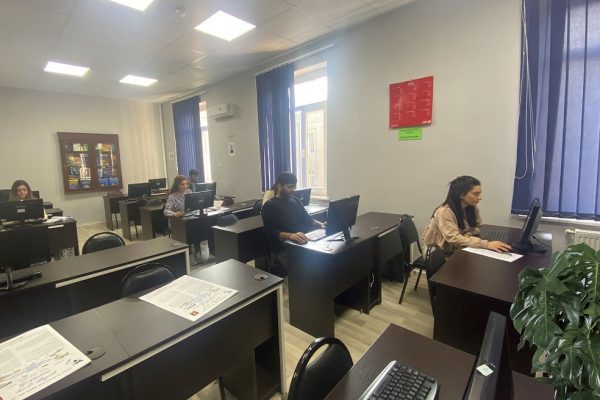


Information – Technology Equipment Space is equipped with modern computers and the internet. Use of computers is permitted only for educational purposes: enter and edit text, search and download materials from the Internet, use e-mail, etc.
Copying, printing and scanning services – The library offers its readers the option of copying and printing different kinds of materials in accordance with copyright rules and requirements. Copying and printing services can be pre-ordered both in person and electronically. To do this, readers have to send an order to the email address: print.library@geomedi.edu.ge with the materials they need.
Meeting and Group Work Space – At our library, it is possible to reserve and use the room for group works. The room can be booked by students, academic and administrative staff of the university. In order to use the room, one has to book it beforehand. To do this, you need to reserve it personally by going to the venue.
Interlibrary Loan Service (ILL) – Provides students and staff with resources not available in the library. To use the service, readers need to contact a librarian and fill out an order form.
Consultation hour with a librarian – Get a personal consultation from a librarian online or in person during the library’s working hours.
Please fill out the registration form
Contact Information: library@geomedi.edu.ge

ELSEVIER – is a leading international publishing company that brings together the world’s latest scientific literature, articles, abstracts, books, etc.
Databases:
ScienceDirect is Elsevier’s leading information platform for researchers, educators, students, healthcare professionals, and more. It provides access to trusted, high-quality, interdisciplinary research, journals, and more.
ScopusCombines bibliographic data, peer-reviewed literature, scientific journals, books, conference proceedings and publications, abstracts and citations, the largest database. Allows researchers to analyze and visualize research, identify current trends, present papers/research worldwide, and gain a reputation in the global scientific community.
The databases can be accessed both from the university and remotely.
For remote access, you need to register individually via institutional email.
Instruction

Cambridge Journals Online – presents journals in humanities and social sciences, as well as natural sciences, including: psychiatry, psychology, neuroscience, epidemiology, public health, medical law, bioethics, mathematics, physics, chemistry, geography, history, philosophy, politics, management, sociology, mass media and communication.

e-Duke Journals Scholarly Collection – Duke University Press presents Journals in the humanities and social sciences are presented: art history, pedagogy, philosophy, gender, international relations, regional and religious studies, sociological theory.

Edward Elgar Publishing Journals and Development Studies e-books – Journals and books on humanitarian and economic issues are presented: economics, innovative research, infrastructure development, healthcare, corporate governance, public and social governance, research methods, legal and other issues. The collection includes scientific monographs, textbooks and reference books.

SAGE Premier – Research articles from top-rated journals in the humanities, social sciences, business, and medicine are presented.

European Respiratory Journal – A database of clinical and experimental medicine, which presents articles in biological, epidemiological, immunological, oncological, etc. directions. At this stage, the impact factor of the journal is 24.9.

Mathematical Sciences Publishers Journals – 17 refereed journals from mathematics and related disciplines are presented, the main areas of which are: mathematics, mechanics, engineering.

Royal Society Journals Collection – Represents scientific journals of a biological nature. Also materials from physics, mathematics and their related disciplines. The collection covers almost all areas of the natural sciences.

ACM Digital Library – The database contains journals, conference proceedings, newspapers, websites, and multimedia files. It also includes computer science literature guides and other cited works.

The Company of Biologists’ Journals – Present a journal that covers the fields of organismal development, cell science, and experimental biology.

OpenEdition Journals – A collection of French-language journals in the humanities and social sciences. The database also has an English-language interface. There are also articles in English, Spanish, Italian, and Portuguese.

Research4Life – Provides access to academic and professional peer-reviewed journals in health, agriculture, environmental protection and social sciences. Includes the following collections:
Hinari – includes health and biomedicine collections.
AGORA – digital library collection in the fields of food and agriculture.
ARDI – provides access to scientific and technical information.
GOALI – focuses on law and social sciences.
OARE – collects information resources on environment, ecology and more.
The databases can be accessed both from the university and remotely. For information on remote use, contact the library.

PubMed Central – An open-access database on biomedicine and life sciences, contains over 10 million records, a digital archive where full texts of publications are available to readers.
Instruction

Eurorad – The world’s largest database of peer-reviewed radiological cases, maintained by the European Society of Radiology (ESR). Offers case-based learning, formatted records of patient history, diagnosis, etc.
Registration is possible via institutional email.